Free shipping, no minimum · 30-day guarantee · Made in Orange, California
The Picnic Cup Holder.com ← back to the picnic page

The picnic file

Why drinks tip over at a picnic — and what actually keeps one standing

A picnic solves the food, the shade, and getting everything there in one trip — and leaves the drink to fend for itself on whatever the blanket is spread over. Here's what's actually happening at ground level, why the gear already in the picnic bag doesn't fix it, and what a working fix has to do that a rigid tool can't.

A blanket is a fabric skin, not a table

A tabletop is rigid and flat; a picnic blanket is neither. It's a textile laid directly over living turf — grass blades, thatch, root humps — with nothing rigid underneath to spread a load across. Picnic-blanket shoppers spend real energy on this exact ground, debating waterproof backing and foam padding in gear-buying threads, because moisture wicks up through plain fabric from damp soil below. The padded, waterproof blankets that solve that problem make the footing softer, not firmer.

Set a narrow-based drink down on that and it finds whatever lump sits under that exact spot, and leans to match it. Worse, the blanket is one continuous surface: a knee coming down for the cheese board, a corner tugged for legroom — it travels through the fabric to every cup standing on it, not just the one nearest the disturbance.

The grass is graded, and the good spots are sloped

Once the blanket fills up, drinks get exiled to the grass at its edge, and that ground isn't flat either. Landscapers grade lawns at roughly 1 to 2 percent — about a quarter inch of fall per foot — specifically so rain runs off instead of pooling. Add sprinkler heads, bare patches, and root humps, and a stretch of lawn that reads level from a seated angle is quietly working against anything standing on it.

The picnic spots people actually want make this worse. Shade trees grow on rises. Amphitheater lawns are raked toward the stage on purpose. At venues built around a century-old bring-your-own-picnic tradition, where wine is welcome at most shows, the whole lawn crowd pitches a blanket on that exact grade for the length of a concert, with cups and bottles and no furniture at all. Slope stacks gravity on top of softness: a bottle that might survive flat, lumpy grass rolls on a grade, and a tall cup leans its rim past its own base. After dark, nobody sees it happen — pack-up finds the casualty by touch, in the wet spot.

What's already in the picnic bag, and where each fix stalls

Ground-stake glass holders solve the softness by pinning into it — a spike driven into the lawn with a ring sized for a wine glass. That only works where the ground accepts a spike; drought-baked turf in a real August is the opposite of accommodating, and stakes bend. One Etsy seller sells a dedicated "hard ground pilot" tool for exactly this — a spike-driving problem common enough to need its own accessory. The rings fit stemware only, so a can, a tumbler, or a stemless cup gets nothing, and the idea is useless the moment the picnic lands on a table instead of grass.

The folding bamboo wine table — a low, fold-flat table with a bottle hole and cut slots — solves it differently, but the slots are sized for a wine glass stem by the sellers' own listings, on Amazon, Home Depot, and Etsy alike. Everything else people bring sits on the open tabletop of a table built light enough to carry, which makes it light enough to tip; reviewers flag wobble on uneven grass and legs that sink crooked into soft turf.

The cooler lid becomes the drinks table by default, and it's a poor one twice over: the molded-in holders some lids ship with grip only a fraction of an inch, and the lid is a trapdoor that has to open for every ice check and refill, taking everything on it along for the ride — usually into the grass, "just for a second." Between openings, condensation keeps the crowned plastic slick.

Wondering about your specific cup? The fit database has sourced base measurements for 30+ containers — Stanley, Red Bull, Yeti, and the honest no's.

Not every picnic drink is the same shape — and that's the real problem

Tipping isn't only about the ground; it's about the relationship between a container's height and the width of what it's standing on. A short, wide object needs a real shove to walk its center of gravity past the edge of its own base. A tall, narrow one barely needs a nudge — which is why a plastic champagne flute is the tippiest thing on any blanket, tall and top-heavy on a base the size of a coin, and why toasts so often happen with the glass still in hand.

The rest of what shows up runs the same math. A 750 ml wine bottle stands nearly a foot tall on a base only about 3 inches across, so it usually ends up on its side or wedged against the hamper between pours. A standard 12 oz can starts with a wider, steadier 2.60-inch base, but gets lighter and easier to tip as it empties — and by late summer, an open can left on its side in the grass does double duty: extension entomologists note that yellowjacket colonies are hunting hard for sugar by then, and a spilled sweet drink is a standing invitation. Even the 40 oz insulated tumbler that now comes to the park as routinely as the gym isn't exempt — about 11 inches tall on a base right around 3.1 inches, top-heavy the moment it's full.

What actually holds steady on ground like this

Every fix examined here assumes a fixed geometry: a spike depth the ground has to accept, a slot cut for one stem width, a flat plane that already has to exist. Picnic ground doesn't offer any of that — it's soft, uneven, sloped, or all three, and the one rigid surface in the scene is usually bolted down somewhere else.

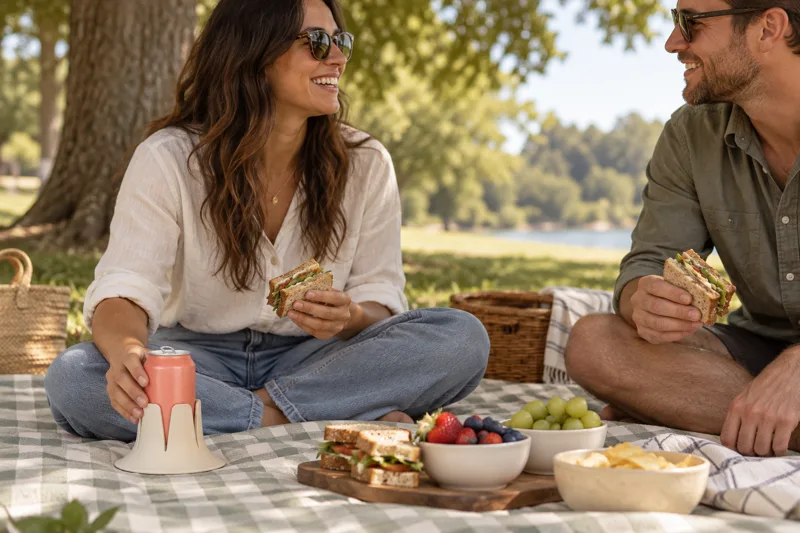
What actually works takes the opposite approach: a base wide enough to bridge the lumps instead of finding one to lean on, and flexible fins gripping the container's bottom inch instead of a slot cut for a single shape. That covers a container base from 2 to 3 inches across — can, stemless cup, bottle, tumbler — with the fins flexing to seat bases as wide as 3.15 inches too, a snug fit just above that range. A stemmed flute's coin-sized base is the honest exception; nothing this wide grips something that narrow, which is exactly why picnic tables and ground stakes cut stem slots in the first place. For the drinks that do fit, a knee landing nearby doesn't send the drink hunting for a new angle — the base flexes with the surface and settles it back level.

None of it needs a spike, a stem-shaped slot, or ground firm enough to accept one — just a base wide enough to bridge the lumps under a blanket and fins that grip whatever's actually in hand, from a canned wine to a 40 oz tumbler. That's what resists tipping when the only flat thing at the picnic is the cheese board.

Get set up at steadilabs.com →

You'll check out on steadilabs.com, the maker's own site.